You are sitting in a high-stakes meeting, nodding along while a colleague throws around a highly specific technical term. Everyone else is nodding too. You have absolutely no idea what it means. Your gut tells you to raise your hand and speak up. Your ego, however, screams at you to stay quiet, copy the phrase into Google later, and pretend you are completely on top of things.
By staying silent, you just bought yourself a temporary pass from embarrassment. You also just signed up for a lifetime of quiet anxiety.
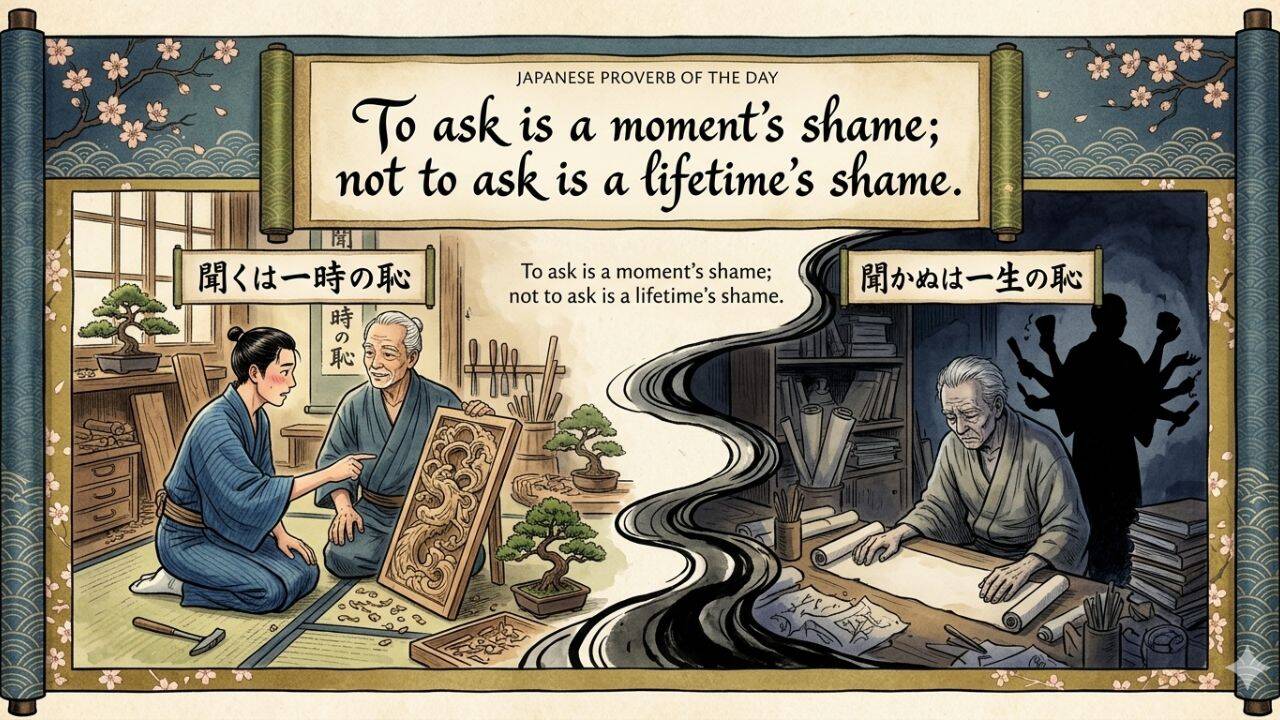
The Japanese have a perfect phrase for this exact moment of mental friction: Kiku wa ittoki no haji, kikanu wa issho no haji. Translated directly, it means: To ask is a moment's shame; not to ask is a lifetime's shame.
It is an incredibly simple concept that almost everyone intellectually understands but routinely fails to practice. We treat our ignorance like a dark secret. We guard it fiercely because we confuse not knowing with lacking intelligence. But the reality of modern life is that the cost of pretending to know things is skyrocketing.
The Cultural Roots of the Silent Traps
It makes complete sense that this piece of wisdom originates from Japan. Japanese society deeply values wa (social harmony) and the concept of saving face. Standing out in a group by admitting you do not comprehend something takes a massive amount of internal leverage. The pressure to fit in smoothly is intense.
This proverb serves as a cultural pressure valve. It explicitly states that a minor, momentary loss of face is an absolute bargain compared to the alternative.
When you ask a question, you expose a temporary gap. Your chest tightens, your face might get hot, and you feel exposed for exactly five seconds. Then, someone explains it. The gap closes. You possess the knowledge forever.
When you choose silence, you choose a slow-burning poison. You keep your pride intact for the afternoon, but you leave the room missing a crucial piece of the puzzle. Next week, that missing piece becomes relevant again. Now you definitely cannot ask, because you were supposed to have figured it out last week. The lie grows. You start actively avoiding certain conversations or projects because you are terrified someone will pull back the curtain on your ignorance.
A tiny moment of avoided awkwardness snowballs into a multi-year psychological tax.
The Brutal Financial and Career Cost of False Competence
Vague advice about "being curious" doesn't change behavior. Let's look at the actual math of staying silent in a professional environment.
Consider a software engineer or a financial analyst who joins a new team. During onboarding, a senior colleague explains a core legacy system or an intricate tax structure. The newcomer doesn't get it but nods anyway to look sharp.
A month later, that foundational misunderstanding causes a major system crash or a costly compliance error. According to data from the Project Management Institute (PMI), poor communication and unaddressed misunderstandings contribute to a massive percentage of project failures globally. In fact, their data shows that for every billion dollars spent on projects, roughly 135 million is wasted due to poor communication.
A single five-second question—"Hey, can you break down that specific step one more time?"—costs zero dollars. Running a broken process for six months because you were too proud to look uneducated costs thousands of dollars and ruins your reputation.
The professional world is filled with people who are pretending. The irony is that the most capable executives and operators usually ask the most basic, seemingly stupid questions. They don't care about looking flawless in the room; they care about getting the data right so they can make the correct decision.
The Strategy for Asking Without Feeling Tiny
You can't just tell yourself to stop feeling embarrassed. Fear doesn't vanish because of a proverb. You need a practical framework to ask hard questions without triggering your internal defense mechanisms.
First, own the timeline. The absolute best time to admit you do not know something is the very first time you hear it. Use a script that strips away the emotion: "I'm completely new to this specific framework, can you give me the high-level summary?" People love being experts. They will gladly explain it to you because it strokes their own ego.
Second, prove you did the baseline homework. There is a massive difference between lazy asking and strategic asking. Do not ask someone to explain something you could have found in a two-second search. Instead, frame your question around your current boundary of knowledge: "I looked over the project brief and I understand part A and B, but the transition to part C isn't clicking for me. What am I missing there?" This shows you are competent, active, and merely hit a specific roadblock.
Third, change the environment for the people around you. If you lead a team, manage projects, or raise kids, how you respond to questions dictates whether people lie to you. If someone asks a basic question and you reply with sarcasm or impatience, you just guaranteed they will hide their next mistake from you. Praise clarity over performative confidence.
What to Do Right Now
The next time you feel that familiar internal squeeze—the desire to nod along with something you don't actually grasp—use these concrete steps to break the habit:
- Catch the physical cue. Notice when your throat tightens or you find yourself typing a term into your phone under the table.
- Interrupt the script. Remind yourself of the transaction: five seconds of an awkward face vs. six months of faking it.
- Speak immediately. Do not let the meeting move on past the point of your confusion. Say: "Hold on a second, let's back up to that last metric. I want to make sure I fully understand the baseline before we move forward."
Take the short, sharp sting of a moment's shame. It is the cheapest insurance policy for your career and peace of mind you will ever find.